
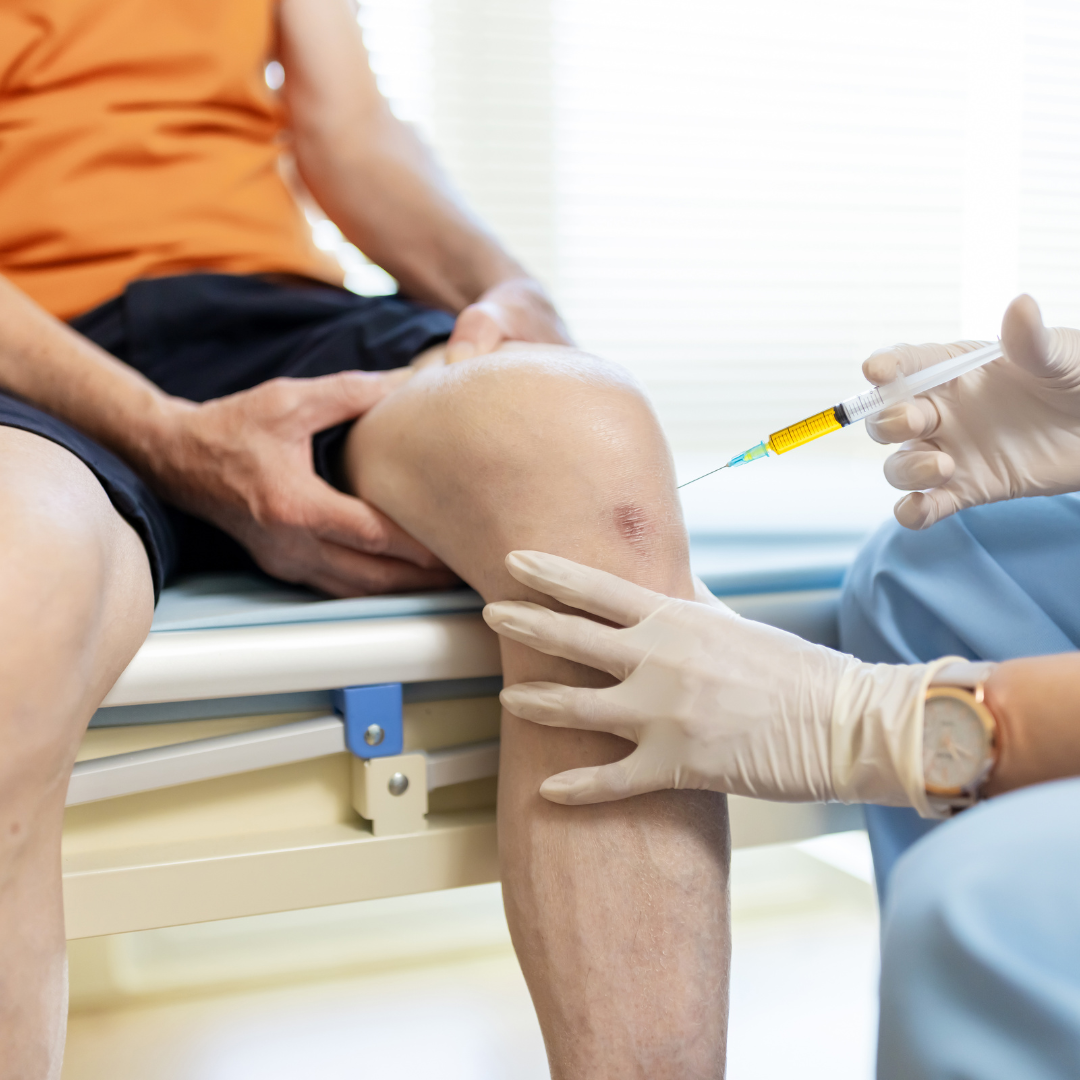
Steroid injections are frequently used for treatment of joint pain, osteoarthritis, bursitis, tendinitis, plantar fasciitis, and sciatica.
I’ve had discussions about steroid injections with family members in the past, and opinions concerning their effectiveness have always been mixed.
My mom swears by them, claiming a steroid injection did wonders for her shoulder when a bone spur started shredding the muscle.
My brother, on the other hand, experienced no benefit after trying a steroid injection twice for back pain.
And my husband has no desire to ever have a steroid injection again for plantar fasciitis. He says that was the most painful thing he has ever experienced. He couldn’t walk for several days!
It has certainly been questioned whether or not steroid injections provide any lasting form of pain relief.
The Cochrane Review (2015) reports there is no lasting effect of steroid injections after 6 months. Another study shows, after 12 months, study participants who received steroid injections for back pain were similar to those who did not receive injections, experiencing
- Disc inflammation
- Lower quality or life
- More anxiety and depression (than people without back pain), and
- Continued use of non-narcotic pills.
More disturbing than the lack of effectiveness or longevity, though, is the growing evidence that steroid injections may be causing more harm than good.
Have you ever wondered why doctors limit steroid injections to no more than 3-4 a year?

A study in Radiology notes patients who received steroid injections experienced faster progression of their osteoarthritis, rapid joint destruction, and bone loss.
A 2-year study published by the Journal of American Medicine Association showed participants getting steroid injections had greater knee cartilage loss than those who didn’t get injections, and NO significant decrease in pain levels.
And the Mayo clinic lists the top 4 risk factors for steroid injections as cartilage damage, death of the nearby bone, joint infection, and nerve damage.
The risk of bone, cartilage, and damage to the joint structure CANNOT be ignored in exchange for something that offers the possibility for quick pain relief.
Especially when that quick pain relief is little more than a band-aid aimed at reducing inflammation. It does nothing to address what is causing the inflammation in the first place.
And do not fool yourself, despite how good you might feel after a steroid injection, there can be no lasting relief without also addressing the cause of the problem.
That’s where we come in.
Back and hip pain are things we frequently see and treat at Women’s Myofascial Of Salt Lake.
And we know it is possible to recover a body that is strong and feels good, without the harmful effects of steroid injections.
It isn’t difficult to do once you stop ignoring and avoiding problems, or putting band-aids on them, and start properly addressing the connective tissue system of the body.
How Can Myofascial Release Help Back Pain And Hip Pain?
Work with a myofascial specialist will help create an environment in your body in which tissues can heal. This natural healing process will help complete any thwarted inflammatory responses so joints can move without pain.
In addition, your body will have the space it needs in the myofascial tissues to self correct, move with more ease, and have better posture with less effort.
If you would like to learn more about how you can recover a back, hip, or shoulder that is strong and feels good while avoiding the harmful effects of steroid injections, give us a call or fill our the form below for a FREE phone consultation.


Sources
“Intradiscal Glucocorticoid Injection for Patients With Chronic Low Back Pain Associated With Active Discopathy”. Christelle Nguyen, M.D., Ph.D., Byron Schneider M.D.; Annals of Internal Medicine: March 20, 2017
https://doi.org/10.7326/M16-1700
“Intra-articular Corticosteroid Injections in the Hip and Knee: Perhaps Not as Safe as We Thought?” Radiology VOL. 293, NO. 3, Published Online: Oct 15 2019 https://doi.org/10.1148/radiol.2019190341
“Effect of Intra-articular Triamcinolone vs Saline on Knee Cartilage Volume and Pain in Patients With Knee Osteoarthritis: A Randomized Clinical Trial.”, JAMA. 2017 May 16;317(19):1967-1975. doi: 10.1001/jama.2017.5283
“Cortisone Shots.” Mayo Clinic. https://www.mayoclinic.org